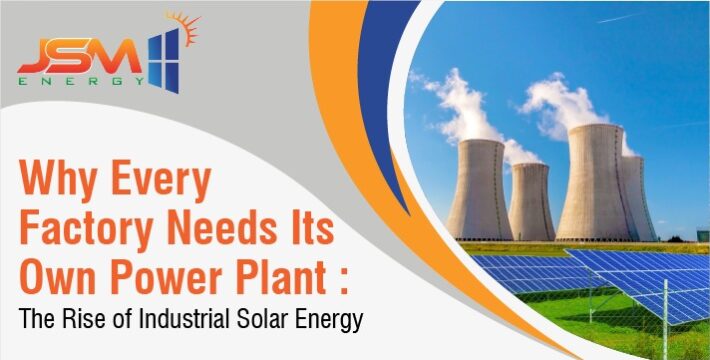
Why Every Factory Needs Its Own Power Plant—The Rise of Industrial Solar Energy
Introduction: Powering the Future of Industry
India’s industrial landscape has one constant challenge, which is the high and unpredictable electricity cost. In fact, manufacturing and processing companies will typically see their energy bills make up almost 30 to 40 percent of their total operating costs. The frequency of grid blackouts, changing prices, and reliance on diesel generators all contribute to the unpredictability of the situation.
Under such circumstances, the idea of an independently operating factory—solar-powered—has quickly gained popularity. The emergence of Industrial Solar Energy alters the perceptions of energy independence, operational safety, and environmental sustainability in the case of factories.
The fact that global sustainability targets, along with India’s renewable energy ambitions, are pushing the pace, and that solar power would not be merely a green option but rather a lucrative business investment, is a realization of companies.
The Core Benefits of Having an On-Site Solar Power Plant
Factories today are not merely adopting solar power for its environmental appeal; they are doing so because it makes strong financial and operational sense. Let’s explore why more industries are turning to industrial solar power plants as their go-to energy solution.
-
Predictable and Lower Energy Costs
The classic electricity prices have a tendency to vary based on several factors like changes in the price of fuel, grid inefficiencies, and policy changes. On the other hand, a captive solar power plant guarantees constant pricing. The Levelized Cost of Energy (LCOE) for solar power remains fixed for 20–25 years once the system is operational, thereby not increasing the cost of electricity for factories due to power hikes.
Not only that plants need less power to operate, and also Eco-friendly grid power or coal dust power can mean energy costs cut by 50 percent at the maximum, which leads to huge yearly savings. This financial predictability enables the industry to plan budgets with more reliability and to distribute the resources optimally.
-
Energy Security and Production Reliability
Unreliable power supplies mean low efficiency output in the manufacturing sector. A short outage can just as easily stop the work, break the equipment, and rearrange the production calendar. A solar power installation with battery storage guarantees that the operation goes on uninterrupted by the instability of the grid.
The battery storage will also allow the factory to continue the continuous production during power cuts, thus reducing downtime and improving the overall efficiency.
-
Sustainability and Regulatory Compliance
Sustainability is an ingredient of contemporary industry. Companies are held responsible for decreasing their greenhouse gas emissions, fulfilling ESG (Environmental, Social, and Governance) criteria, and complying with the government’s renewable energy goals in India.
By switching to Solar for their Industrial Solar Energy needs, factories can cut their CO₂ emissions drastically and at the same time obtain higher sustainability ratings. Besides, the solar plants in many places are opened up for tax benefits and others like shortening of the payback period and issuing of credits for renewable energy, which will help in both the environment and the pocket.
-
Operational Control and Scalability
An on-site solar plant brings remarkable power control to factories, which cannot be equalled by grid power. The plants can decide whether to increase capacity or not, absorb load spikes, and use electricity wisely according to production schedules.
Industry Solar Systems possess the property of being modular—the plants can begin with a small installation and then increase the capacity to the same level as the demand. Such a setup guarantees that the power infrastructure will be transformed along with the business growth.
-
Financial Flexibility and Return on Investment
The solar system is adjusted to different financial models that the company can choose based on its cash flow and investment strategy.
- CAPEX Model: The Company owns the solar system, enjoying full returns and tax benefits.
- PPA (Power Purchase Agreement): The solar developer installs and maintains the system, and the factory buys the power at a fixed rate.
- Lease Model: The Company pays for usage without ownership, ensuring predictable monthly costs.
Generally, the return period for solar energy in factories is about 3 to 5 years — after setting aside the cost of energy for this period, the power becomes almost free for the rest of the system’s life.
Technical Considerations for Factories
Implementing Industrial Solar Energy requires careful planning to maximize efficiency and reliability.
Site Assessment and System Design
Factories must first assess whether rooftops, ground areas, or parking spaces can host solar panels. JSM Energy’s engineers conduct detailed site feasibility studies to evaluate sunlight availability, shadow analysis, and structural strength before designing the system.
System Sizing and Load Matching
Each factory has unique energy consumption patterns—some operate 24×7, others in shifts. The solar system must align with this load profile to optimize utilization and minimize export losses.
Integration with Existing Electrical Systems
Modern solar systems integrate seamlessly with factory power networks. Inverters, switchgear, and synchronization panels ensure safe and efficient energy transfer between solar and grid sources.
Energy Storage and Monitoring
For industries facing frequent power disruptions, battery storage solutions provide additional security. Combined with intelligent monitoring systems, factories can track performance, savings, and CO₂ reductions in real time.
Business Models and Financing Options
The affordability of industrial solar power has improved dramatically over the past decade, thanks to government incentives and technological advancements. Companies can now choose from multiple investment options:
|
Model |
Ownership |
Upfront Cost |
Benefits |
|
CAPEX |
Factory |
High |
Full ROI, tax savings |
|
PPA |
Developer |
None |
No investment, pay per unit |
|
Lease |
Third party |
Moderate |
Fixed monthly payment |
Green financing and ESG-linked loans are also available for solar projects, enabling industries to switch to clean power with minimal capital burden.
Real-World Example: A Manufacturing Unit’s Solar Success
A factory of medium size producing auto components located in Gujarat collaborated with JSM Energy for the establishment of a solar system on the rooftop that has a capacity of 1 MW.
- Before Solar: Monthly electricity bill = ₹18 lakhs
- After Solar: 55% of energy needs met by solar
- Annual Savings: ₹1.2 crore
- Payback Period: 4.2 years
- CO₂ Reduction: ~1,200 tons annually
The savings were not the only advantage; the factory also benefited by gaining a more reliable supply and getting adherence to the international sustainability standards that have made it possible for the factory to attract new global customers who prioritize green operations.
Addressing Common Concerns
- “Solar is too expensive.”
Not anymore. With PPAs and government subsidies, industries can switch to solar with zero upfront investment. - “We don’t have enough space.”
Solutions like carport solar, ground-mounted, or hybrid rooftop systems can make use of existing factory space efficiently. - “Maintenance is difficult.”
Modern solar systems require minimal upkeep. JSM Energy offers comprehensive O&M services, ensuring optimal performance with minimal intervention.
Implementation Roadmap: 6 Practical Steps
- Energy Audit & Load Profiling—Understand your current consumption.
- Site Feasibility Study – Assess available area and sunlight.
- System Design & Financing Plan – Choose between CAPEX, PPA, or lease models.
- Approvals & Procurement—Get necessary permits and materials.
- Installation & Commissioning—Complete setup and grid synchronization.
- Monitoring & Maintenance—Continuous performance optimization.
JSM Energy simplifies each step with end-to-end project management.
How JSM Energy Empowers Industrial Solar Transformation
At JSM Energy, we believe every factory deserves control over its energy future. Our turnkey solutions cover everything—from project design and financing support to installation, monitoring, and maintenance.
With years of experience in Industrial Solar Energy, we deliver:
- Tailored solar designs suited for industrial loads.
- Rapid project execution with minimal production downtime.
- Reliable after-sales service and performance guarantees.
- Flexible financial models for every business scale.
Our goal is simple: make solar energy accessible, affordable, and efficient for every industry in India.
Conclusion: Power Independence is the Future
As sectors increasingly look for steady expenses, eco-friendliness, and dependable power, Industrial Solar Energy emerges as the most sensible and rewarding route ahead. Possessing a solar facility not only reduces outlay but also boosts fortitude against the coming energy unpredictability.
By teaming up with associates such as JSM Energy, manufacturing sites can make the bold move towards a greener, more autonomous tomorrow—where energy self-reliance fuels industry expansion.
Call to Action
Ready to make your factory energy independent?
Contact JSM Energy today for a free site assessment and discover how much you can save with Industrial Solar Energy.

Leave a Comment